Evan A. Sultanik, Ph.D.

Evan's First Name @ Sultanik .com

Computer Security Researcher
Trail of Bits

Recent Content:

Can chatbots craft correct code?

an update to an argument I made in 2017

I recently attended the AI Engineer Code Summit in New York, an invite-only gathering of AI leaders and engineers. One theme emerged repeatedly in conversations with attendees building with AI: the belief that we’re approaching a future where developers will never need to look at code again. When I pressed these proponents, several made a similar argument:

Forty years ago, when high-level programming languages like C became increasingly popular, some of the old guard resisted because C gave you less control than assembly. The same thing is happening now with LLMs.

On its face, this analogy seems reasonable. Both represent increasing abstraction. Both initially met resistance. Both eventually transformed how we write software. But this analogy really thrashes my cache because it misses a fundamental distinction that matters more than abstraction level: determinism.

The difference between compilers and LLMs isn’t just about control or abstraction. It’s about semantic guarantees. And as I’ll argue, that difference has profound implications for the security and correctness of software.

As I wrote back in 2017 in “Automation of Automation,” there are fundamental limits on what we can automate. But those limits don’t eliminate determinism in the tools we’ve built; they simply mean we can’t automatically prove every program correct. Compilers don’t try to prove your program correct; they just faithfully translate it.

This is an excerpt from the Trail of Bits blog. You can read the full post here.

Speedrunning the New York Subway

in which I am nerd-sniped into finding the shortest route that visits every NYC subway station

It all began, as many great adventures do, at Empire Hacking. There, I encountered the inimitable @ImmigrantJackson, a YouTuber with a penchant for public transit and a dream: to break the world record for visiting every subway stop in New York City in the least time possible. (And, of course, to film the journey, what for those delicious likes, comments, and subscriptions.)

The only problem was: Immigrant Jackson didn’t know the fastest route. Surrounded by a room full of Trail of Bits computer scientists, he figured he’d ask our advice. The rules were simple. He didn’t need to exit the subway car; simply passing through a stop, even on an express train, counted as a “visit.” Stops could be visited multiple times, although this would of course be suboptimal. And there was no need to visit Staten Island … because we’re civilized. We live in a society. So, where should he start, and what would be the best route?

The coterie of curious computer coders coalescing around the inquisitor quickly classified this question as a case of the Traveling Salesman Problem (TSP). TSP is a classical problem in computer science in which one must find the shortest route for a traveling salesman to visit each city on a map. TSP is known to be computationally intractable to solve optimally for networks even as small as the New York subway system. Therefore, everyone dismissed the problem as “impossible.”

Except for me.

You see, my now-ancient PhD dissertation was on combinatorial optimization and approximation algorithms: tools for solving problems like TSP efficiently with a result that is not necessarily optimal, but at least close to optimal. I knew that there were algorithms capable of solving TSP very quickly, producing a route guaranteed to be at most 50% longer than the optimal solution. In fact, one of the results of my dissertation was the surprising revelation that even if you choose a feasible route at random, it will, on average, be only thrice the length of the optimal solution.

This, dear reader, was how I was nerd-sniped into optimizing (speedrunning?) the NYC subway.

The first challenge was that, even when you discard Staten Italy, the subway system still has a lot of stations. There are close to 500. This exercise was fun and all, but I wasn’t about to spend hours encoding hundreds of stations, lines, transfer points, headways, and average trip times into a program.

There is an open standard for specifying public transit data: the General Transit Feed Specification (GTFS). Fortunately, the MTA has a public API implementing GTFS. It’s just a collection of CSV files that are quite straightforward to parse. The dataset is sufficient to construct a graph with a node for each subway station and an edge if there is a subway line that connects the two stations. Actually, the data represents subway platforms rather than stations, which is necessary to calculate things like transfer times between train lines.

The New York Subway network is a directed graph: some neighboring stations are accessible to each other only in one direction. For example, the Aqueduct Racetrack station only has a platform for northbound trains, not southbound trains. The best algorithms for approximating a solution to TSP on directed graphs are not great, only guaranteeing a solution of three or four times the length of the optimal solution. Therefore, I decided to relax the problem to an undirected graph (i.e., I assume that every station has trains to its neighbors bidirectionally). This turned out not to be an issue and permitted the use of the Christofides algorithm, which guarantees a solution at most 50% longer than optimal.

The next and final relaxation is to partially ignore actual timetables and headways. When a transfer between lines is necessary, I assume that the transfer will require the “minimum transfer time” reported by GTFS (i.e., the amount of time required to walk from one platform to another) plus one-half the average headway for that line throughout the day. Therefore, the resulting route has the potential to strand the poor YouTuber on the last train at the end of a line. Validating the resulting route’s real-world feasibility is left as an exercise to the reader.

The Christofides algorithm was able to approximate a solution to the TSP for my relaxed subway network graph in a matter of milliseconds. This is compared to the unfathomable amount of computation required to brute-force calculate the optimal solution, an amount so large that it afforded me the horrifying opportunity to learn that there is a whole community of “googologists” who compete with each other to name large numbers. We’re talking googolchime levels of computation. Guppybell levels, even!

The resulting tour visits all 474 stations, 155 of which are visited more than once. The tour requires 34 transfers. The expected time for completing this tour is 20 hours, 42 minutes. That’s about 45 minutes faster than the record, which was about 21 and a half hours.

This is neat and all, but we spent an unnecessary amount of energy encoding the New York subway system as a graph. What else might we do with it? One straightforward computation is to calculate each station’s eigenvector centrality. Imagine you’re given the Sisyphean task of riding the subway for all eternity. Every time you arrive at a station, you flip a coin. If it’s heads, you stay on the current train. If it’s tails, you get off and transfer to another line or direction. If you were to pause your infinite tour at any arbitrary point in time, what’s the probability that you are at a particular station? The higher the probability, the more “centrally connected” the station. That’s exactly what eigenvector centrality calculates.

Eigenvector centrality is actually what Google originally used in its PageRank algorithm to rank the relative importance (centrality) of web pages. Each page is like a subway station, and hyperlinks on the page are like the subway lines connecting them. Eigenvector centrality is relatively easy to calculate, either directly (it’s related to the eigenspectrum of the graph’s adjacency matrix, thanks to spooky spectral graph theory magic) or using a technique called power iteration (which relies on a convergence that happens when you multiply the adjacency matrix by a vector a bunch of times). Either way, you can calculate it with a single function call in NetworkX.

What do you think will be the most probable stop on your infinite subway tour? Or, another way to ask the same question: Which stop will you visit most often on your tour? Unsurprisingly, it will be Times Square, with a probability of a little over 30%. The next most probable station is 42nd St. Port Authority Bus Terminal, coming in at about 8%. Then 50th St., 59th St. Columbus Circle, Grand Central 42nd St., and 34th St. Penn Station are all between 4% and 5%.

So, what have we learned? First of all, don’t attend Empire Hacking without the expectation of being intellectually stimulated. Secondly, don’t immediately discount a problem just because it is NP-hard or computationally intractable to solve; you might be able to approximate a solution of sufficient optimality. Thirdly, Times Square may not be the “center of the universe,” but it is definitely the center of the New York subway system. Finally, remember to like, comment, and subscribe!

Click to see the complete tour route!1 (0.0hrs): Far Rockaway-Mott Av
2 (0.0hrs): Beach 25 St
3 (0.1hrs): Beach 36 St
4 (0.1hrs): Beach 44 St
5 (0.1hrs): Beach 60 St
6 (0.1hrs): Beach 67 St
7 (0.2hrs): Broad Channel
8 (0.3hrs): Beach 90 St
9 (0.3hrs): Beach 98 St
10 (0.3hrs): Beach 105 St
11 (0.4hrs): Rockaway Park-Beach 116 St
12 (0.4hrs): Beach 105 St (visit 2)
13 (0.4hrs): Beach 98 St (visit 2)
14 (0.4hrs): Beach 90 St (visit 2)
15 (0.5hrs): Broad Channel (visit 2)
16 (0.6hrs): Howard Beach-JFK Airport
17 (0.7hrs): Aqueduct-N Conduit Av
18 (0.7hrs): Aqueduct Racetrack
19 (0.7hrs): Rockaway Blvd
20 (0.8hrs): 104 St
21 (0.8hrs): 111 St
22 (0.9hrs): Ozone Park-Lefferts Blvd
23 (0.9hrs): 111 St (visit 2)
24 (0.9hrs): 104 St (visit 2)
25 (0.9hrs): Rockaway Blvd (visit 2)
26 (0.9hrs): 88 St
27 (1.0hrs): 80 St
28 (1.0hrs): Grant Av
29 (1.0hrs): Euclid Av
30 (1.0hrs): Shepherd Av
31 (1.1hrs): Van Siclen Av
32 (1.1hrs): Liberty Av
33 (1.1hrs): Broadway Junction
transfer lines
34 (1.2hrs): Broadway Junction
35 (1.2hrs): Alabama Av
36 (1.3hrs): Van Siclen Av
37 (1.3hrs): Cleveland St
38 (1.3hrs): Norwood Av
39 (1.3hrs): Crescent St
40 (1.4hrs): Cypress Hills
41 (1.4hrs): 75 St-Elderts Ln
42 (1.4hrs): 85 St-Forest Pkwy
43 (1.4hrs): Woodhaven Blvd
44 (1.5hrs): 104 St
45 (1.5hrs): 111 St
46 (1.5hrs): 121 St
47 (1.6hrs): Sutphin Blvd-Archer Av-JFK Airport
48 (1.7hrs): Jamaica Center-Parsons/Archer
49 (1.7hrs): Sutphin Blvd-Archer Av-JFK Airport (visit 2)
50 (1.7hrs): Jamaica-Van Wyck
51 (1.7hrs): Briarwood
52 (1.8hrs): Sutphin Blvd
53 (1.8hrs): Parsons Blvd
54 (1.9hrs): 169 St
55 (2.0hrs): Jamaica-179 St
56 (2.0hrs): 169 St (visit 2)
57 (2.0hrs): Parsons Blvd (visit 2)
58 (2.1hrs): Sutphin Blvd (visit 2)
59 (2.1hrs): Briarwood (visit 2)
60 (2.1hrs): Kew Gardens-Union Tpke
61 (2.2hrs): 75 Av
62 (2.2hrs): Forest Hills-71 Av
63 (2.2hrs): 67 Av
64 (2.2hrs): 63 Dr-Rego Park
65 (2.3hrs): Woodhaven Blvd
66 (2.3hrs): Grand Av-Newtown
67 (2.3hrs): Elmhurst Av
68 (2.4hrs): Jackson Hts-Roosevelt Av
69 (2.4hrs): 65 St
70 (2.4hrs): Northern Blvd
71 (2.4hrs): 46 St
72 (2.5hrs): Steinway St
73 (2.5hrs): 36 St
74 (2.5hrs): Queens Plaza
75 (2.6hrs): Court Sq-23 St
76 (2.6hrs): Lexington Av/53 St
77 (2.6hrs): 5 Av/53 St
78 (2.7hrs): 7 Av
79 (2.7hrs): 50 St
80 (2.7hrs): 42 St-Port Authority Bus Terminal
81 (2.8hrs): 34 St-Penn Station
82 (2.8hrs): 23 St
83 (2.8hrs): 14 St
84 (2.9hrs): W 4 St-Wash Sq
85 (2.9hrs): Spring St
86 (2.9hrs): Canal St
87 (2.9hrs): World Trade Center
88 (3.0hrs): Canal St (visit 2)
89 (3.0hrs): Chambers St
90 (3.0hrs): Fulton St
transfer lines
91 (3.1hrs): Fulton St
92 (3.1hrs): Wall St
93 (3.1hrs): Bowling Green
94 (3.2hrs): Wall St (visit 2)
95 (3.2hrs): Fulton St (visit 2)
96 (3.2hrs): Brooklyn Bridge-City Hall
97 (3.2hrs): Canal St
98 (3.3hrs): Brooklyn Bridge-City Hall (visit 2)
transfer lines
99 (3.3hrs): Chambers St
100 (3.4hrs): Fulton St
101 (3.4hrs): Broad St
102 (3.4hrs): Fulton St (visit 2)
103 (3.4hrs): Chambers St (visit 2)
104 (3.5hrs): Canal St
105 (3.5hrs): Bowery
106 (3.5hrs): Delancey St-Essex St
107 (3.6hrs): Bowery (visit 2)
108 (3.6hrs): Canal St (visit 2)
transfer lines
109 (3.6hrs): Canal St (visit 2)
110 (3.7hrs): Spring St
111 (3.7hrs): Bleecker St
112 (3.7hrs): Astor Pl
113 (3.7hrs): 14 St-Union Sq
114 (3.8hrs): 23 St
115 (3.8hrs): 28 St
116 (3.8hrs): 33 St
117 (3.8hrs): Grand Central-42 St
118 (3.9hrs): 51 St
119 (3.9hrs): 59 St
120 (3.9hrs): 68 St-Hunter College
121 (3.9hrs): 77 St
122 (4.0hrs): 86 St
123 (4.0hrs): 96 St
124 (4.0hrs): 103 St
125 (4.0hrs): 110 St
126 (4.1hrs): 116 St
127 (4.1hrs): 125 St
128 (4.1hrs): 3 Av-138 St
129 (4.3hrs): Hunts Point Av
130 (4.4hrs): Parkchester
131 (4.4hrs): Castle Hill Av
132 (4.4hrs): Zerega Av
133 (4.4hrs): Westchester Sq-E Tremont Av
134 (4.5hrs): Middletown Rd
135 (4.5hrs): Buhre Av
136 (4.5hrs): Pelham Bay Park
137 (4.6hrs): Buhre Av (visit 2)
138 (4.6hrs): Middletown Rd (visit 2)
139 (4.6hrs): Westchester Sq-E Tremont Av (visit 2)
140 (4.6hrs): Zerega Av (visit 2)
141 (4.7hrs): Castle Hill Av (visit 2)
142 (4.7hrs): Parkchester (visit 2)
143 (4.7hrs): St Lawrence Av
144 (4.7hrs): Morrison Av-Soundview
145 (4.8hrs): Elder Av
146 (4.8hrs): Whitlock Av
147 (4.8hrs): Hunts Point Av (visit 2)
148 (4.8hrs): Longwood Av
149 (4.9hrs): E 149 St
150 (4.9hrs): E 143 St-St Mary’s St
151 (4.9hrs): Cypress Av
152 (4.9hrs): Brook Av
153 (5.0hrs): 3 Av-138 St (visit 2)
154 (5.0hrs): 125 St (visit 2)
155 (5.1hrs): 138 St-Grand Concourse
156 (5.1hrs): 149 St-Grand Concourse
transfer lines
157 (5.2hrs): 149 St-Grand Concourse
158 (5.2hrs): 3 Av-149 St
159 (5.4hrs): E 180 St
160 (5.4hrs): Morris Park
161 (5.5hrs): Pelham Pkwy
162 (5.5hrs): Gun Hill Rd
163 (5.5hrs): Baychester Av
164 (5.6hrs): Eastchester-Dyre Av
165 (5.6hrs): Baychester Av (visit 2)
166 (5.7hrs): Gun Hill Rd (visit 2)
167 (5.7hrs): Pelham Pkwy (visit 2)
168 (5.7hrs): Morris Park (visit 2)
169 (5.8hrs): E 180 St (visit 2)
170 (5.8hrs): Bronx Park East
171 (5.9hrs): Pelham Pkwy
172 (5.9hrs): Allerton Av
173 (5.9hrs): Burke Av
174 (5.9hrs): Gun Hill Rd
175 (6.0hrs): 219 St
176 (6.0hrs): 225 St
177 (6.0hrs): 233 St
178 (6.0hrs): Nereid Av
179 (6.1hrs): Wakefield-241 St
180 (6.1hrs): Nereid Av (visit 2)
181 (6.2hrs): 233 St (visit 2)
182 (6.2hrs): 225 St (visit 2)
183 (6.2hrs): 219 St (visit 2)
184 (6.2hrs): Gun Hill Rd (visit 2)
185 (6.4hrs): E 180 St (visit 3)
186 (6.4hrs): West Farms Sq-E Tremont Av
187 (6.4hrs): 174 St
188 (6.5hrs): Freeman St
189 (6.5hrs): Simpson St
190 (6.5hrs): Intervale Av
191 (6.5hrs): Prospect Av
192 (6.6hrs): Jackson Av
193 (6.6hrs): 3 Av-149 St (visit 2)
194 (6.6hrs): 149 St-Grand Concourse (visit 2)
195 (6.7hrs): 135 St
196 (6.7hrs): 145 St
197 (6.8hrs): Harlem-148 St
198 (6.8hrs): 145 St (visit 2)
199 (6.8hrs): 135 St (visit 2)
200 (6.9hrs): 125 St
201 (6.9hrs): 116 St
202 (6.9hrs): Central Park North (110 St)
203 (7.0hrs): 96 St
204 (7.0hrs): 72 St
205 (7.1hrs): 66 St-Lincoln Center
206 (7.1hrs): 59 St-Columbus Circle
transfer lines
207 (7.1hrs): 59 St-Columbus Circle
208 (7.2hrs): 7 Av (visit 2)
209 (7.2hrs): 47-50 Sts-Rockefeller Ctr
210 (7.2hrs): 57 St
211 (7.2hrs): 47-50 Sts-Rockefeller Ctr (visit 2)
212 (7.3hrs): 42 St-Bryant Pk
213 (7.3hrs): 34 St-Herald Sq
214 (7.3hrs): 23 St
215 (7.3hrs): 14 St
216 (7.4hrs): W 4 St-Wash Sq
217 (7.4hrs): Broadway-Lafayette St
218 (7.4hrs): Grand St
219 (7.5hrs): Broadway-Lafayette St (visit 2)
220 (7.5hrs): 2 Av
221 (7.5hrs): Delancey St-Essex St
222 (7.6hrs): East Broadway
223 (7.6hrs): York St
224 (7.6hrs): Jay St-MetroTech
transfer lines
225 (7.7hrs): Jay St-MetroTech
226 (7.7hrs): DeKalb Av
227 (7.7hrs): Atlantic Av-Barclays Ctr
228 (7.8hrs): 7 Av
229 (7.8hrs): Prospect Park
230 (7.9hrs): Parkside Av
231 (7.9hrs): Church Av
232 (7.9hrs): Beverley Rd
233 (7.9hrs): Cortelyou Rd
234 (8.0hrs): Newkirk Plaza
235 (8.0hrs): Avenue H
236 (8.0hrs): Avenue J
237 (8.0hrs): Avenue M
238 (8.1hrs): Kings Hwy
239 (8.1hrs): Avenue U
240 (8.1hrs): Neck Rd
241 (8.2hrs): Sheepshead Bay
242 (8.2hrs): Brighton Beach
243 (8.2hrs): Ocean Pkwy
244 (8.3hrs): W 8 St-NY Aquarium
245 (8.3hrs): Coney Island-Stillwell Av
246 (8.3hrs): W 8 St-NY Aquarium (visit 2)
247 (8.4hrs): Neptune Av
248 (8.4hrs): Avenue X
249 (8.4hrs): Avenue U
250 (8.4hrs): Kings Hwy
251 (8.5hrs): Avenue P
252 (8.5hrs): Avenue N
253 (8.5hrs): Bay Pkwy
254 (8.5hrs): Avenue I
255 (8.6hrs): 18 Av
256 (8.6hrs): Ditmas Av
257 (8.6hrs): Church Av
258 (8.6hrs): Fort Hamilton Pkwy
259 (8.7hrs): 15 St-Prospect Park
260 (8.7hrs): 7 Av
261 (8.7hrs): 4 Av-9 St
262 (8.8hrs): Smith-9 Sts
263 (8.8hrs): Carroll St
264 (8.8hrs): Bergen St
265 (8.9hrs): Hoyt-Schermerhorn Sts
266 (8.9hrs): Lafayette Av
267 (8.9hrs): Clinton-Washington Avs
268 (8.9hrs): Franklin Av
transfer lines
269 (9.0hrs): Franklin Av
transfer lines
270 (9.0hrs): Franklin Av (visit 2)
271 (9.1hrs): Nostrand Av
272 (9.1hrs): Kingston-Throop Avs
273 (9.1hrs): Utica Av
274 (9.2hrs): Ralph Av
275 (9.2hrs): Rockaway Av
276 (9.2hrs): Broadway Junction (visit 2)
transfer lines
277 (9.3hrs): Broadway Junction
278 (9.3hrs): Atlantic Av
279 (9.3hrs): Sutter Av
280 (9.3hrs): Livonia Av
281 (9.4hrs): New Lots Av
282 (9.4hrs): East 105 St
283 (9.4hrs): Canarsie-Rockaway Pkwy
284 (9.4hrs): East 105 St (visit 2)
285 (9.5hrs): New Lots Av (visit 2)
286 (9.5hrs): Livonia Av (visit 2)
transfer lines
287 (9.6hrs): Junius St
288 (9.6hrs): Pennsylvania Av
289 (9.6hrs): Van Siclen Av
290 (9.7hrs): New Lots Av
291 (9.7hrs): Van Siclen Av (visit 2)
292 (9.7hrs): Pennsylvania Av (visit 2)
293 (9.7hrs): Junius St (visit 2)
294 (9.7hrs): Rockaway Av
295 (9.8hrs): Saratoga Av
296 (9.8hrs): Sutter Av-Rutland Rd
297 (9.8hrs): Crown Hts-Utica Av
298 (9.9hrs): Kingston Av
299 (9.9hrs): Nostrand Av
300 (9.9hrs): Franklin Av-Medgar Evers College
301 (10.0hrs): President St-Medgar Evers College
302 (10.0hrs): Sterling St
303 (10.0hrs): Winthrop St
304 (10.1hrs): Church Av
305 (10.1hrs): Beverly Rd
306 (10.2hrs): Newkirk Av-Little Haiti
307 (10.2hrs): Flatbush Av-Brooklyn College
308 (10.2hrs): Newkirk Av-Little Haiti (visit 2)
309 (10.2hrs): Beverly Rd (visit 2)
310 (10.3hrs): Church Av (visit 2)
311 (10.3hrs): Winthrop St (visit 2)
312 (10.3hrs): Sterling St (visit 2)
313 (10.3hrs): President St-Medgar Evers College (visit 2)
314 (10.4hrs): Franklin Av-Medgar Evers College (visit 2)
315 (10.4hrs): Eastern Pkwy-Brooklyn Museum
316 (10.5hrs): Grand Army Plaza
317 (10.5hrs): Bergen St
318 (10.5hrs): Atlantic Av-Barclays Ctr
transfer lines
319 (10.6hrs): Atlantic Av-Barclays Ctr
320 (10.7hrs): 36 St
321 (10.7hrs): 9 Av
322 (10.8hrs): Fort Hamilton Pkwy
323 (10.8hrs): 50 St
324 (10.8hrs): 55 St
325 (10.8hrs): 62 St
transfer lines
326 (10.9hrs): New Utrecht Av
327 (10.9hrs): 18 Av
328 (10.9hrs): 20 Av
329 (11.0hrs): Bay Pkwy
330 (11.0hrs): Kings Hwy
331 (11.0hrs): Avenue U
332 (11.0hrs): 86 St
333 (11.1hrs): Coney Island-Stillwell Av (visit 2)
334 (11.2hrs): Bay 50 St
335 (11.3hrs): 25 Av
336 (11.3hrs): Bay Pkwy
337 (11.3hrs): 20 Av
338 (11.3hrs): 18 Av
339 (11.3hrs): 79 St
340 (11.4hrs): 71 St
341 (11.4hrs): 62 St (visit 2)
transfer lines
342 (11.5hrs): New Utrecht Av (visit 2)
343 (11.5hrs): Fort Hamilton Pkwy
344 (11.5hrs): 8 Av
345 (11.6hrs): 59 St
346 (11.6hrs): Bay Ridge Av
347 (11.6hrs): 77 St
348 (11.7hrs): 86 St
349 (11.7hrs): Bay Ridge-95 St
350 (11.7hrs): 86 St (visit 2)
351 (11.8hrs): 77 St (visit 2)
352 (11.8hrs): Bay Ridge Av (visit 2)
353 (11.8hrs): 59 St (visit 2)
354 (11.9hrs): 53 St
355 (11.9hrs): 45 St
356 (11.9hrs): 36 St (visit 2)
357 (12.0hrs): 25 St
358 (12.0hrs): Prospect Av
359 (12.0hrs): 4 Av-9 St
360 (12.0hrs): Union St
361 (12.1hrs): Atlantic Av-Barclays Ctr (visit 2)
transfer lines
362 (12.1hrs): Atlantic Av-Barclays Ctr (visit 2)
363 (12.2hrs): Nevins St
364 (12.2hrs): Borough Hall
365 (12.2hrs): Nevins St (visit 2)
366 (12.2hrs): Hoyt St
367 (12.3hrs): Borough Hall
transfer lines
368 (12.3hrs): Court St
369 (12.4hrs): Jay St-MetroTech (visit 2)
transfer lines
370 (12.4hrs): Jay St-MetroTech (visit 2)
371 (12.4hrs): High St
372 (12.4hrs): Jay St-MetroTech (visit 3)
373 (12.5hrs): Hoyt-Schermerhorn Sts (visit 2)
374 (12.5hrs): Fulton St
375 (12.5hrs): Clinton-Washington Avs
376 (12.6hrs): Classon Av
377 (12.6hrs): Bedford-Nostrand Avs
378 (12.6hrs): Myrtle-Willoughby Avs
379 (12.6hrs): Flushing Av
380 (12.7hrs): Broadway
381 (12.7hrs): Metropolitan Av
382 (12.7hrs): Nassau Av
383 (12.8hrs): Greenpoint Av
384 (12.8hrs): 21 St
385 (12.8hrs): Court Sq
transfer lines
386 (12.9hrs): Court Sq
387 (12.9hrs): Hunters Point Av
388 (12.9hrs): Vernon Blvd-Jackson Av
389 (12.9hrs): Hunters Point Av (visit 2)
390 (13.0hrs): Court Sq (visit 2)
391 (13.0hrs): Queensboro Plaza
transfer lines
392 (13.0hrs): Queensboro Plaza
393 (13.0hrs): 39 Av-Dutch Kills
394 (13.1hrs): 36 Av
395 (13.1hrs): Broadway
396 (13.1hrs): 30 Av
397 (13.1hrs): Astoria Blvd
398 (13.2hrs): Astoria-Ditmars Blvd
399 (13.2hrs): Astoria Blvd (visit 2)
400 (13.2hrs): 30 Av (visit 2)
401 (13.2hrs): Broadway (visit 2)
402 (13.3hrs): 36 Av (visit 2)
403 (13.3hrs): 39 Av-Dutch Kills (visit 2)
404 (13.3hrs): Queensboro Plaza (visit 2)
transfer lines
405 (13.3hrs): Queensboro Plaza (visit 2)
406 (13.4hrs): 33 St-Rawson St
407 (13.4hrs): 40 St-Lowery St
408 (13.4hrs): 46 St-Bliss St
409 (13.4hrs): 52 St
410 (13.5hrs): 61 St-Woodside
411 (13.5hrs): 69 St
412 (13.5hrs): 74 St-Broadway
413 (13.5hrs): 82 St-Jackson Hts
414 (13.5hrs): 90 St-Elmhurst Av
415 (13.6hrs): Junction Blvd
416 (13.6hrs): 103 St-Corona Plaza
417 (13.6hrs): 111 St
418 (13.6hrs): Mets-Willets Point
419 (13.7hrs): Flushing-Main St
420 (13.8hrs): Mets-Willets Point (visit 2)
421 (13.8hrs): Junction Blvd (visit 2)
422 (13.9hrs): 74 St-Broadway (visit 2)
transfer lines
423 (13.9hrs): Jackson Hts-Roosevelt Av (visit 2)
424 (14.0hrs): Queens Plaza (visit 2)
425 (14.1hrs): Lexington Av/59 St
426 (14.2hrs): 5 Av/59 St
427 (14.2hrs): 57 St-7 Av
428 (14.3hrs): Lexington Av/63 St
429 (14.3hrs): 72 St
430 (14.3hrs): 86 St
431 (14.4hrs): 96 St
432 (14.4hrs): 86 St (visit 2)
433 (14.4hrs): 72 St (visit 2)
434 (14.5hrs): Lexington Av/63 St (visit 2)
435 (14.5hrs): Roosevelt Island
436 (14.6hrs): 21 St-Queensbridge
437 (14.6hrs): Roosevelt Island (visit 2)
438 (14.6hrs): Lexington Av/63 St (visit 3)
439 (14.7hrs): 57 St-7 Av (visit 2)
440 (14.7hrs): 49 St
441 (14.8hrs): Times Sq-42 St
transfer lines
442 (14.8hrs): Times Sq-42 St
transfer lines
443 (14.9hrs): Times Sq-42 St
444 (14.9hrs): Grand Central-42 St
transfer lines
445 (15.0hrs): Grand Central-42 St
446 (15.0hrs): 5 Av
447 (15.0hrs): Times Sq-42 St
448 (15.1hrs): 34 St-Hudson Yards
449 (15.1hrs): Times Sq-42 St (visit 2)
transfer lines
450 (15.2hrs): Times Sq-42 St (visit 2)
451 (15.2hrs): 34 St-Herald Sq
452 (15.2hrs): 28 St
453 (15.2hrs): 23 St
454 (15.3hrs): 14 St-Union Sq
455 (15.3hrs): 8 St-NYU
456 (15.3hrs): Prince St
457 (15.4hrs): Canal St
transfer lines
458 (15.4hrs): Canal St
459 (15.4hrs): City Hall
460 (15.5hrs): Cortlandt St
461 (15.5hrs): Rector St
462 (15.5hrs): Whitehall St-South Ferry
transfer lines
463 (15.6hrs): South Ferry Loop
transfer lines
464 (15.6hrs): Whitehall St-South Ferry (visit 2)
465 (15.7hrs): Court St (visit 2)
transfer lines
466 (15.7hrs): Borough Hall (visit 2)
467 (15.7hrs): Clark St
468 (15.8hrs): Wall St
469 (15.8hrs): Fulton St
470 (15.9hrs): Park Place
471 (15.9hrs): Chambers St
472 (15.9hrs): WTC Cortlandt
473 (15.9hrs): Rector St
474 (16.0hrs): South Ferry
475 (16.0hrs): Rector St (visit 2)
476 (16.0hrs): WTC Cortlandt (visit 2)
477 (16.0hrs): Chambers St (visit 2)
478 (16.1hrs): Franklin St
479 (16.1hrs): Canal St
480 (16.1hrs): Houston St
481 (16.1hrs): Christopher St-Sheridan Sq
482 (16.2hrs): 14 St
483 (16.2hrs): 18 St
484 (16.2hrs): 23 St
485 (16.2hrs): 28 St
486 (16.2hrs): 34 St-Penn Station
487 (16.3hrs): Times Sq-42 St (visit 2)
488 (16.3hrs): 50 St
489 (16.3hrs): 59 St-Columbus Circle (visit 2)
490 (16.3hrs): 66 St-Lincoln Center (visit 2)
491 (16.4hrs): 72 St (visit 2)
492 (16.4hrs): 79 St
493 (16.4hrs): 86 St
494 (16.4hrs): 96 St (visit 2)
495 (16.5hrs): 103 St
496 (16.5hrs): Cathedral Pkwy (110 St)
497 (16.5hrs): 116 St-Columbia University
498 (16.5hrs): 125 St
499 (16.6hrs): 137 St-City College
500 (16.6hrs): 145 St
501 (16.6hrs): 157 St
502 (16.7hrs): 168 St-Washington Hts
503 (16.7hrs): 181 St
504 (16.7hrs): 191 St
505 (16.7hrs): Dyckman St
506 (16.8hrs): 207 St
507 (16.8hrs): 215 St
508 (16.8hrs): Marble Hill-225 St
509 (16.8hrs): 231 St
510 (16.9hrs): 238 St
511 (16.9hrs): Van Cortlandt Park-242 St
512 (16.9hrs): 238 St (visit 2)
513 (17.0hrs): 231 St (visit 2)
514 (17.0hrs): Marble Hill-225 St (visit 2)
515 (17.0hrs): 215 St (visit 2)
516 (17.0hrs): 207 St (visit 2)
517 (17.1hrs): Dyckman St (visit 2)
518 (17.1hrs): 191 St (visit 2)
519 (17.1hrs): 181 St (visit 2)
520 (17.1hrs): 168 St-Washington Hts (visit 2)
transfer lines
521 (17.2hrs): 168 St
522 (17.3hrs): 175 St
523 (17.3hrs): 181 St
524 (17.3hrs): 190 St
525 (17.4hrs): Dyckman St
526 (17.4hrs): Inwood-207 St
527 (17.5hrs): Dyckman St (visit 2)
528 (17.5hrs): 190 St (visit 2)
529 (17.5hrs): 181 St (visit 2)
530 (17.5hrs): 175 St (visit 2)
531 (17.6hrs): 168 St (visit 2)
532 (17.6hrs): 163 St-Amsterdam Av
533 (17.6hrs): 155 St
534 (17.6hrs): 145 St
535 (17.7hrs): 135 St
536 (17.7hrs): 145 St
537 (17.8hrs): Tremont Av
538 (17.9hrs): Fordham Rd
539 (17.9hrs): Kingsbridge Rd
540 (18.0hrs): Bedford Park Blvd
541 (18.0hrs): Norwood-205 St
542 (18.0hrs): Bedford Park Blvd (visit 2)
543 (18.1hrs): Kingsbridge Rd (visit 2)
544 (18.1hrs): Fordham Rd (visit 2)
545 (18.2hrs): 182-183 Sts
546 (18.2hrs): Tremont Av (visit 2)
547 (18.2hrs): 174-175 Sts
548 (18.2hrs): 170 St
549 (18.3hrs): 167 St
550 (18.3hrs): 161 St-Yankee Stadium
transfer lines
551 (18.4hrs): 161 St-Yankee Stadium
552 (18.4hrs): 167 St
553 (18.4hrs): 170 St
554 (18.4hrs): Mt Eden Av
555 (18.5hrs): 176 St
556 (18.5hrs): Burnside Av
557 (18.5hrs): 183 St
558 (18.5hrs): Fordham Rd
559 (18.6hrs): Kingsbridge Rd
560 (18.6hrs): Bedford Park Blvd-Lehman College
561 (18.6hrs): Mosholu Pkwy
562 (18.7hrs): Woodlawn
563 (18.7hrs): Mosholu Pkwy (visit 2)
564 (18.7hrs): Bedford Park Blvd-Lehman College (visit 2)
565 (18.8hrs): Kingsbridge Rd (visit 2)
566 (18.8hrs): Fordham Rd (visit 2)
567 (18.8hrs): 183 St (visit 2)
568 (18.8hrs): Burnside Av (visit 2)
569 (18.9hrs): 167 St (visit 2)
570 (19.0hrs): 161 St-Yankee Stadium (visit 2)
transfer lines
571 (19.0hrs): 161 St-Yankee Stadium (visit 2)
572 (19.0hrs): 155 St
573 (19.1hrs): 145 St (visit 2)
574 (19.1hrs): 125 St
575 (19.1hrs): 116 St
576 (19.2hrs): Cathedral Pkwy (110 St)
577 (19.2hrs): 103 St
578 (19.2hrs): 96 St
579 (19.2hrs): 86 St
580 (19.3hrs): 81 St-Museum of Natural History
581 (19.3hrs): 72 St
582 (19.3hrs): 59 St-Columbus Circle (visit 2)
583 (19.3hrs): 42 St-Port Authority Bus Terminal (visit 2)
584 (19.4hrs): 34 St-Penn Station (visit 2)
585 (19.4hrs): 14 St (visit 2)
transfer lines
586 (19.4hrs): 8 Av
587 (19.5hrs): 6 Av
588 (19.5hrs): 14 St-Union Sq
589 (19.5hrs): 3 Av
590 (19.5hrs): 1 Av
591 (19.6hrs): Bedford Av
592 (19.6hrs): Lorimer St
593 (19.6hrs): Graham Av
594 (19.7hrs): Grand St
595 (19.7hrs): Montrose Av
596 (19.7hrs): Morgan Av
597 (19.7hrs): Jefferson St
598 (19.8hrs): DeKalb Av
599 (19.8hrs): Myrtle-Wyckoff Avs
600 (19.8hrs): Halsey St
601 (19.9hrs): Wilson Av
602 (19.9hrs): Bushwick Av-Aberdeen St
603 (19.9hrs): Broadway Junction (visit 2)
604 (19.9hrs): Bushwick Av-Aberdeen St (visit 2)
605 (20.0hrs): Wilson Av (visit 2)
606 (20.0hrs): Halsey St (visit 2)
607 (20.0hrs): Myrtle-Wyckoff Avs (visit 2)
transfer lines
608 (20.1hrs): Myrtle-Wyckoff Avs
609 (20.1hrs): Seneca Av
610 (20.1hrs): Forest Av
611 (20.2hrs): Fresh Pond Rd
612 (20.2hrs): Middle Village-Metropolitan Av
613 (20.2hrs): Fresh Pond Rd (visit 2)
614 (20.3hrs): Forest Av (visit 2)
615 (20.3hrs): Seneca Av (visit 2)
616 (20.3hrs): Myrtle-Wyckoff Avs (visit 2)
617 (20.3hrs): Knickerbocker Av
618 (20.4hrs): Central Av
619 (20.4hrs): Myrtle Av
620 (20.5hrs): Marcy Av
621 (20.5hrs): Hewes St
622 (20.5hrs): Lorimer St
623 (20.6hrs): Flushing Av
624 (20.6hrs): Myrtle Av (visit 2)
625 (20.6hrs): Kosciuszko St
626 (20.6hrs): Gates Av
627 (20.7hrs): Halsey St
628 (20.7hrs): Chauncey St
629 (20.7hrs): Broadway Junction (visit 2)

This is an excerpt from the Trail of Bits blog. You can read the full post here.

Detecting code copying at scale with Vendetect

a new tool that can discover coded copied between repositories

Earlier this month, the maintainer of Cheating-Daddy discovered that a Y-Combinator-funded startup had copied their GPL-licensed codebase, stripped out the comments, and re-released it as “Glass” under an incompatible license. This isn’t an isolated incident; we see code theft and improper vendoring constantly during security assessments. So we built a tool to catch it automatically.

Vendetect is our new open-source tool for detecting copied and vendored code between repositories. It uses semantic fingerprinting to identify similar code even when variable names change or comments disappear. More importantly, unlike academic plagiarism detectors, it understands version control history, helping you trace vendored code back to its exact source commit.

This is an excerpt from the Trail of Bits blog. You can read the full post here.

Investigate your dependencies with Deptective

a new tool that can automatically run any command even if its dependencies are missing

Have you ever tried compiling a piece of open-source software, only to discover that you neglected to install one of its native dependencies? Or maybe a binary “fell off the back of a truck” and you want to try running it but have no idea what shared libraries it needs. Or maybe you need to use a poorly packaged piece of software whose maintainers neglected to list a native dependency.

Deptective, our new open-source tool, solves these problems. You can give it any program, script, or command, and it will find a set of packages sufficient to run the software successfully.

This is an excerpt from the Trail of Bits blog. You can read the full post here.

Preventing account takeover

on centralized cryptocurrency exchanges

This blog post highlights key points from our new white paper Preventing Account Takeovers on Centralized Cryptocurrency Exchanges, which documents ATO-related attack vectors and defenses tailored to CEXes.

Imagine trying to log in to your centralized cryptocurrency exchange (CEX) account and your password and username just… don’t work. You try them again. Same problem. Your heart rate increases a little bit at this point, especially since you are using a password manager. Maybe a service outage is all that’s responsible (knock on wood), and your password will work again as soon as it’s fixed? But it is becoming increasingly likely that you’re the victim of an account takeover (ATO).

CEXes’ choices dictate how (or if) the people who use them can secure their funds. Since account security features vary between platforms and are not always documented, the user might not know what to expect nor how to configure their account best for their personal threat model. Design choices like not supporting phishing-resistant multifactor authentication (MFA) methods like U2F hardware security keys, or not tracking user events in order to push in-app “was this you?” account lockdown prompts when anomalies happen invite the attacker in.

Our white paper’s goal is to inform and enable CEXes to provide a secure-by-design platform for their users. Executives can get a high-level overview of the vulnerabilities and entities involved in user account takeover. We recommend a set of overlapping security controls that they can bring to team leads and technical product managers to check for and prioritize if not yet implemented. Security engineers and software engineers can also use our work as a reference for the risks of not integrating, maintaining, and documenting appropriate ATO mitigations.

This is an excerpt from the Trail of Bits blog. You can read the full post here.

Cruising Through Paradoxes

Examining the Dialectics of Leisure and Urbanity

I grew up on the fringes of suburbia, at the cusp of what most would consider rural Pennsylvania. In the Spring, we gagged from the stench of manure. In the Fall, Schools closed on the first day of hunting season. In the Winter, fresh, out-of-season fruits were missing from the grocer. All year round, procuring exotic ingredients like avocados entailed a forty-five-minute drive toward civilization. During the school year, I was the first to be picked up and last to be dropped off by the bus, enduring a ride that was well over an hour each way.

I also grew up in tandem with the burgeoning cruise line industry. My parents quickly adopted that mode of travel, and it eventually became our sole form of vacation. As a kid, it was great: I had the freedom to roam the decks on my own, there were innumerable activities, and an unlimited supply of delicious foods with exotic names like “Consommé Madrilene” and “Contrefilet of Prime Beef Périgueux”. My parents loved it because it kept their kids busy, was very affordable (relative to equivalent landed resorts), and had sufficient calories to satisfy their growing boy’s voracious appetite. This was also a transitional period when cruises were holding onto the vestiges and traditions of luxury ocean liners. All cruise lines had strict dress codes, requiring formal attire some evenings (people brought tuxedos!). The crew were largely Southern and Eastern European. As a kid who had never traveled outside North America, it felt like I was LARPing as James Bond.

When I moved out of my parents’ house for college, I wanted a change of scenery. While I had the option to move to a “college town”, I instead chose to live in a large city. And I loved it. It was like living on a cruise, all year round: Activities galore, amazing food, and all within a short distance of each other. A friend could call me up and say, ”Hey, we are hanging out at [X], would you like to join us?” And, regardless of where X was in the city, I could meet them there within fifteen minutes either by walking, biking, or taking public transport.

I didn’t need cruises anymore.


Preface

This year, for his birthday, my father only had one request: that he and his extended family take a cruise to celebrate. I just returned from that cruise, and it was a very different experience from the ones of my youth.

As an adult who had by this point lived the majority of his life in large cities, all I wanted to do was lay by a pool or, preferably, the beach all day and read a book. Those are both difficult things when you’re sharing a crowded pool space with over six thousand other people, and the ship doesn’t typically dock close to a good beach. Skating rink? Gimmicky specialty restaurants? Luxury shopping spree? Laser tag? Pub trivia? Theater productions? Comedy shows? I can do all of those things any day of the week a short distance from my house. When I vacation, I want to escape all that freneticism.

My wife, kids, and I were the only urbanites in our group, and my parents didn’t seem to comprehend why we had such little interest in all the activities. And then it dawned on me: A cruise is just a simulated city. Why would I want an artificial version of what I already have?

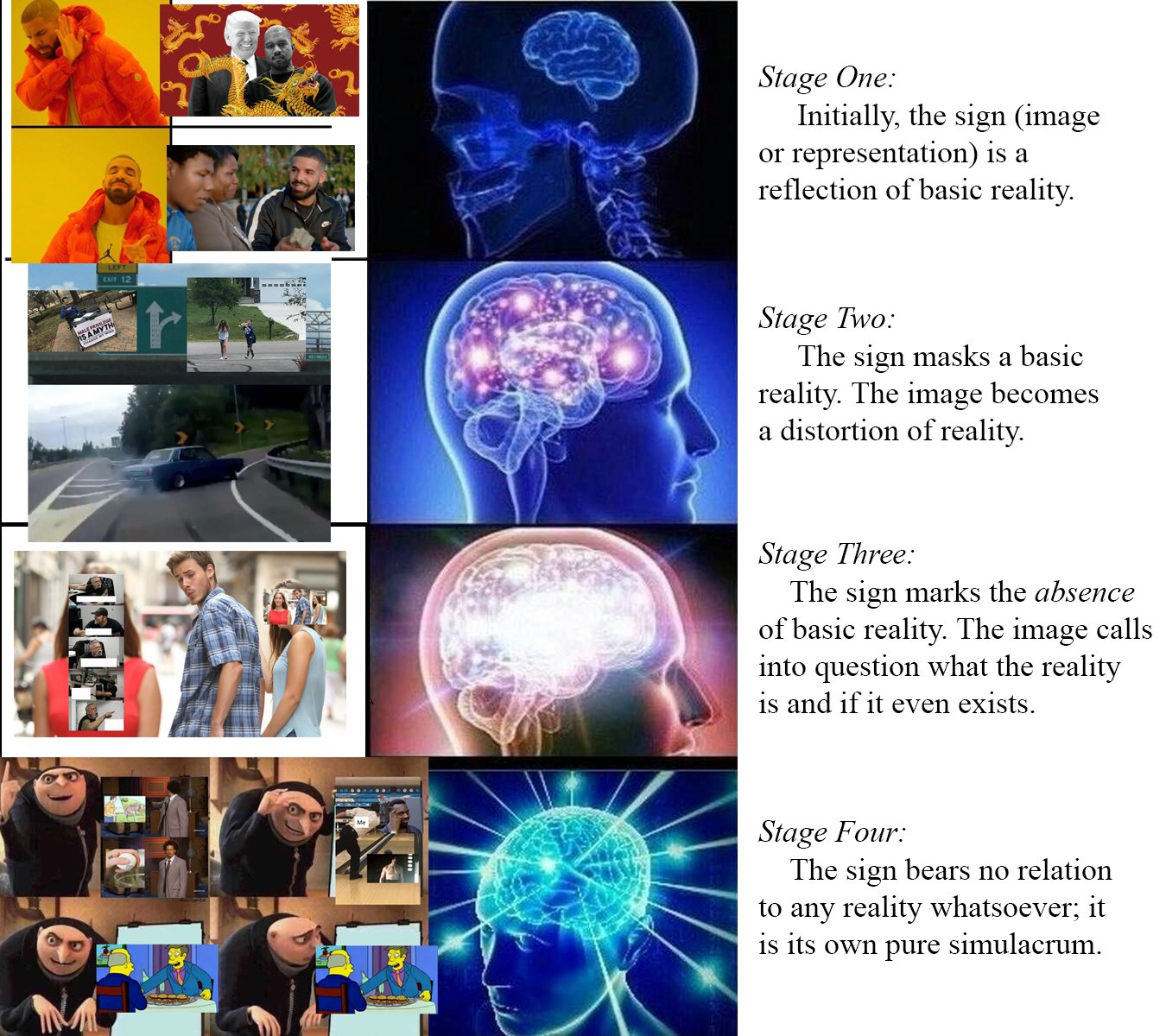
So, lying down on a deck chair, instead of reading my book, I started writing. The idea of simulated urbanism isn’t new, but it’s typically discussed in terms of curated amusement parks like Disney and the emergence of suburban “lifestyle center” developments. Therefore, initially, my goal was to channel this insight into as obnoxious a treatise as possible, in order to trigger my suburbanite traveling companions. Simulated urbanism? That reminded me of Baudrillard! I would make it a completely over-the-top academic analysis of the topic.

Simulacra and Simulation

The following was compiled from a series of texts I sent to our group chat throughout the cruise.


Abstract

This article explores the paradox of vacation preferences among suburban Americans who gravitate toward densely populated environments such as cruises, European cities, and amusement parks, despite residing in sparsely populated areas. It examines how cruises and lifestyle centers, which mimic urban density while offering suburban convenience, satisfy the suburban desire for urban-like experiences. The article contrasts these preferences with those of urban Americans, who experience density daily and may seek different vacation experiences. By analyzing the dynamics of suburban and urban vacation choices, we highlight the complex interplay between suburban living and the pursuit of urban escapism.

Simulated Urbanism

Simulacra and Simulation

The concept of ”simulated urbanism,” as seen in cruise ships and lifestyle centers, can be analyzed through the lens of Jean Baudrillard’s philosophy, particularly his ideas on simulation and hyperreality. Baudrillard argues that in contemporary society, simulations—representations or imitations of reality—have become so pervasive that they blur the distinction between what is real and what is artificially constructed. In the context of simulated urbanism, lifestyle centers and cruise ships serve as hyperreal environments that imitate the vibrancy and density of urban life without the complexities and inconveniences associated with real urban spaces. They provide an experience that is more accessible, manageable, and, in some ways, more appealing than the genuine urban environments they emulate. According to Baudrillard, these simulations can create a sense of hyperreality, where the imitation becomes more influential or desirable than reality itself. Suburban Americans, who are accustomed to the sprawling, car-dependent landscapes of suburbia, find in these simulated urban environments a curated and sanitized version of city life. This artificial urbanism allows them to engage with the aesthetics and experiences of urban density—such as walkability, diverse entertainment, and social interaction—without the perceived drawbacks of real urban living, like congestion, pollution, and crime. Thus, simulated urbanism not only fulfills a desire for the excitement and dynamism of city life but also constructs a hyperreal experience that is tailored to the preferences and comfort of suburban consumers, aligning with Baudrillard’s notion of a society increasingly detached from the authenticity of the real world.

Metamodernism

Suburbanites’ predilections for cruising can be interpreted through the theoretical framework of metamodernism, which posits an oscillation between opposing cultural and experiential paradigms. The cruise experience encapsulates a synthesis of modernist aspirations for progress, order, and structured entertainment, alongside a postmodern sensibility characterized by irony and skepticism towards mass consumerism and the spectacle. This dialectical tension aligns with metamodernism’s core principle of navigating and reconciling contradictions. Within the confines of a cruise, suburbanites engage with the modernist ideal of escape and luxury, encountering a curated simulacrum that offers both adventure and novelty. Simultaneously, they remain cognizant of the inherent artifice and commodification intrinsic to the cruise experience, reflecting a postmodern consciousness of the limitations and constructed nature of such escapism.

Furthermore, the pragmatic idealism inherent in metamodernism is evident in the suburban pursuit of cruising, representing a quest for authenticity within a meticulously orchestrated environment. Suburbanites partake in cruising as a form of meaningful escapism that, although commodified, facilitates genuine opportunities for relaxation, social interaction, and cultural exploration. This dynamic reflects a metamodern synthesis of sincerity and irony, wherein participants seek genuine engagement and fulfillment while maintaining an awareness of the artificial and consumerist underpinnings of the cruise industry. The cruise, thus, serves as a microcosm of metamodern cultural hybridity, integrating diverse influences and experiences into a cohesive assemblage that enables suburbanites to navigate the complexities of contemporary existence with both optimism and reflexivity. This exemplifies the metamodern tension between the yearning for authentic connection and the recognition of its mediated nature, embodying a dialectical interplay that is central to metamodern thought.

Dialectics

(To be read as if dictated by Slavoj Žižek.)

From a Hegelian perspective, urbanites’ preferences for relaxing vacations can be understood through the lens of dialectical progression and the quest for synthesis between opposing elements in their lives. Hegel’s philosophy emphasizes the process of thesis, antithesis, and synthesis, [sniff] where the contradictions and tensions between different aspects of existence lead to the development of higher levels of understanding and being. A dance of contradictions and tensions.

Urbanites are like rats in a maze of their own making, living in this frenetic environment of constant stimulation and complexity. So, what do they do? They escape to a vacation that provides the antithesis of urban life, a necessary counterbalance that allows them to confront the contradictions of their daily existence.

In this dialectical process, the vacation can be seen as a moment of synthesis, where urbanites integrate the contrasting aspects of their existence—work and leisure, complexity and simplicity, stimulation and relaxation. Through this synthesis, they achieve a more harmonious state of being, temporarily resolving the contradictions inherent in their lives. [nose pull] Hegel might argue that this pursuit of balance is part of a broader process of self-realization and development, as individuals continually seek to reconcile opposing forces within themselves and their environments. This dialectical movement reflects a deeper philosophical journey toward self-awareness and fulfillment, where each vacation experience contributes to a more nuanced understanding of personal and existential needs.

Moreover, Hegel would likely emphasize that this process is not static but dynamic, as urbanites constantly redefine and re-evaluate their desires and experiences in pursuit of higher forms of understanding and contentment. [sniff] This ongoing dialectical interaction between urban life and vacation preferences underscores the complexity of human existence and the continuous evolution of individual consciousness within the broader historical and cultural context.

What Would Marx Say?

(For extra fun, to be read as if dictated by Jordan Peterson.)

When we examine the suburbanite’s preference for urban-like vacation experiences—such as cruising or visiting bustling cities—through the lens of Marxist theory, we uncover something quite profound about the alienation inherent in capitalist societies. Suburban life is often marked by routine and compartmentalization, a strong reliance on cars, and an emphasis on private space. This creates an environment of isolation and fragmentation, which Marx identified as symptomatic of capitalist production. The sprawling nature of suburbia physically separates individuals from their workplaces, social hubs, and cultural activities, generating a dichotomy between home life and community engagement. This alienation from collective social experiences mirrors the detachment workers feel from the products of their labor and from each other in a capitalist framework.

Thus, when suburbanites seek out vacations in dense, walkable environments, they’re searching for a temporary reprieve from this isolation. These vacations allow them to engage with the social interactions and cultural experiences that are often missing from their everyday lives. In this way, vacations become a commodified form of leisure within capitalist society, packaged and sold as products designed to alleviate the stresses of alienation and labor. Suburbanites, who feel the pressures of maintaining a lifestyle dictated by capitalist norms—like homeownership and consumerism—turn to vacations as a form of respite from these demands. Cruises and urban vacations offer a concentrated form of entertainment and cultural engagement, providing an illusion of freedom and choice that contrasts with the regulated and constrained nature of suburban life. While these vacations temporarily satisfy the need for genuine human connection and cultural enrichment, Marxist theory would argue that they also reinforce the capitalist cycle, as individuals must return to their suburban routines to earn the means to participate in such leisure activities. Thus, vacations, though they offer a brief escape from alienation, ultimately underscore the pervasive influence of capitalism on leisure and personal fulfillment.

Conclusions

As I reflect on the whirlwind of contradictions, philosophies, and cultural dynamics explored in this article, I must admit that I find myself utterly exhausted. Much like the aftermath of a cruise, where the buffet line feels both endless and insurmountable, I am too fatigued to draw any tidy conclusions. So, dear reader, as I lean back in my metaphorical deck chair, I invite you to navigate these intellectual waters and draw your own conclusions. Like the towel animals on your cabin bed, reality might be folded and shaped in surprising ways, but the essence remains yours to unravel. Bon voyage in your own journey of trolling! Or is it trawling?

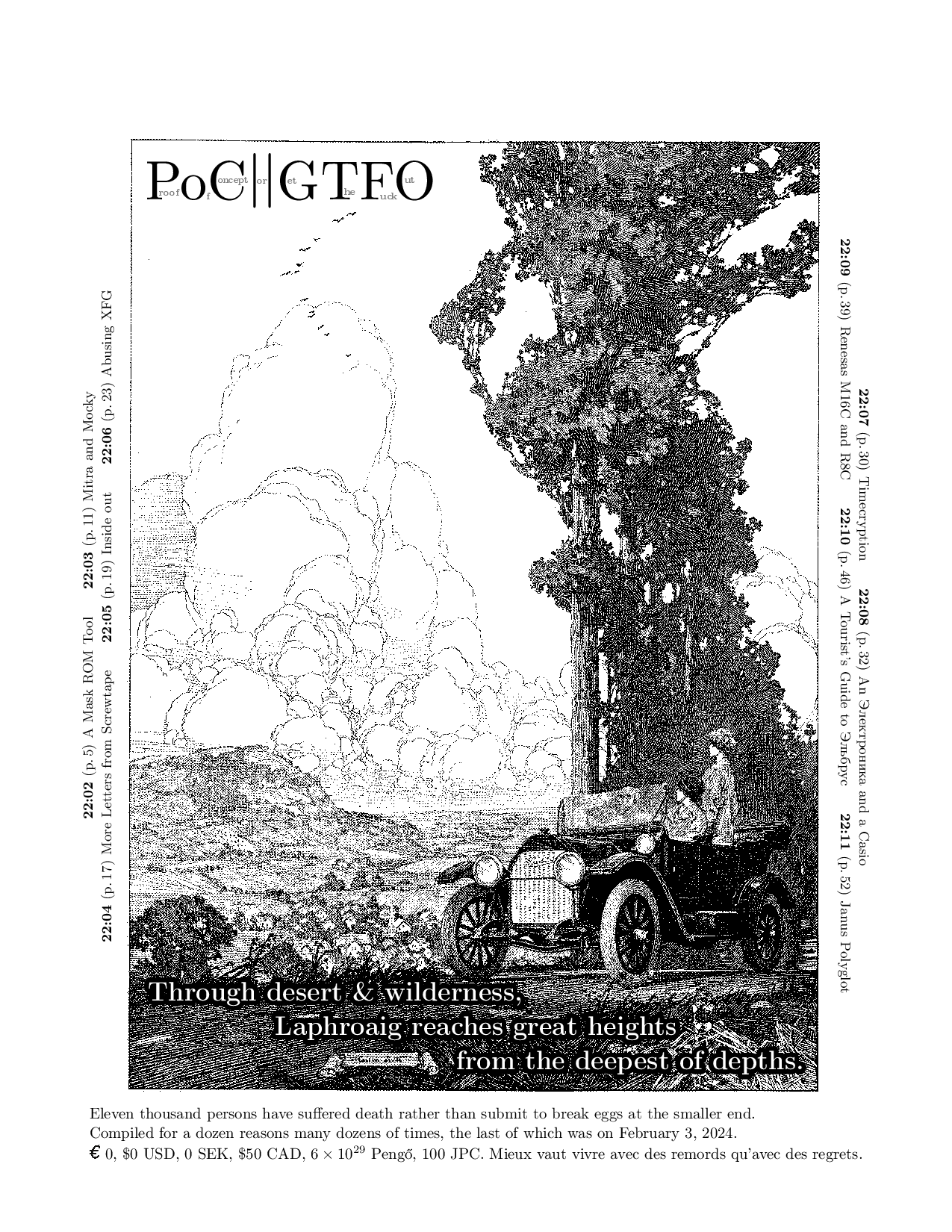
PoC‖GTFO Issue 0x22

Through desert & wilderness, Laphroaig reaches great heights from the deepest of depths.

International Journal of PoC$\|$GTFO

How to avoid the aCropalypse

It could have been prevented if only Google and Microsoft used our tools!

Last week, news about CVE-2023-21036, nicknamed the “aCropalypse,” spread across Twitter and other media, and my colleague Henrik Brodin quickly realized that the underlying flaw could be detected by our tool, PolyTracker. Coincidentally, Henrik Brodin, Marek Surovič, and I wrote a paper that describes this class of bugs, defines a novel approach for detecting them, and introduces our implementation and tooling. It will appear at this year’s workshop on Language-Theoretic Security (LangSec) at the IEEE Security and Privacy Symposium.

The remainder of this blog post describes the bug and how it could have been detected or even prevented using our tools.

This is an excerpt from the Trail of Bits blog. You can read the full post here.

libmagic

The Blathering

A couple of years ago I released PolyFile: a utility to identify and map the semantic structure of files, including polyglots, chimeras, and schizophrenic files. It’s a bit like file, binwalk, and Kaitai Struct all rolled into one. PolyFile initially used the TRiD definition database for file identification. However, this database was both too slow and prone to misclassification, so we decided to switch to libmagic, the ubiquitous library behind the file command.

This is an excerpt from the Trail of Bits blog. You can read the full post here.

PoC‖GTFO Issue 0x21

Notebook of Altera NIOS Disassembly, Routable IPIP Spoofing, PCAP-NG Polyglots, Weird Machinery, Code Golfing, and UHF·VHF Tuners

International Journal of PoC$\|$GTFO